



best 200 Khz Transducer
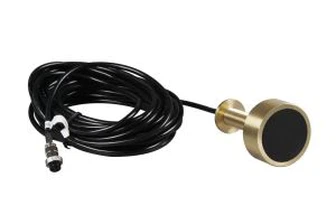
200KHz/1.5KW echo sounder transducer with cable 12m 1. Product Description Transducer depth finder 1500W is made by OVA. Transducer echo sounder is good target detail in shallow-water at 200KHz. Specification Packing&Shipping Company Information Nantong Saiyang Electronics Co., Ltd....
Product Introduction
best 200 Khz echo sounder transducer
Products Description of the best 200 Khz Transducer
The vast, unseen world beneath the waves holds secrets critical to navigation, resource exploration, and scientific understanding. To pierce this aquatic veil, we rely on sophisticated acoustic eyes: echo sounder transducers. Among the diverse options available, the 200kHz, 1.5kW transducer stands out as a powerful and versatile workhorse for demanding shallow-to-medium water applications.
Best 200 Khz Transducer depth finder 1500W is made by OVA.
sonar transducer 200 khz transmits sonar signals (PING) into the water layer, and receives echoes from those transmissions.
advantages of the best 200 Khz Transducer
The Significance of 200kHz: High Resolution Meets Practical Depth
Frequency is the cornerstone of sonar performance. A 200kHz operating frequency offers distinct advantages:
1. Superior Resolution: Higher frequencies produce shorter acoustic wavelengths. This translates directly into finer detail. A 200kHz system can resolve smaller objects, detect subtle bottom features like ripples or debris, and provide crisper imagery of structures or fish schools. Imagine the difference between a standard definition and a high-definition TV picture – that's the resolution boost higher frequencies like 200kHz provide.
2. Target Discrimination: The shorter wavelength allows the sounder to distinguish between closely spaced objects on the seafloor or within the water column. This is crucial for identifying fish species, mapping complex bottom types (e.g., distinguishing rocks from sand patches), or detecting small underwater hazards.
3. Reduced Beam Spread (Narrow Beam): Higher frequencies naturally produce narrower acoustic beams from similarly sized transducers. This tight beam focuses acoustic energy more precisely downward, minimizing side-echo interference ("clutter") and providing a cleaner, more accurate depth reading directly beneath the vessel. It also improves positional accuracy for targets within the beam.
4. Practical Depth Range: While higher frequencies attenuate (lose energy) faster in water than lower frequencies, 200kHz strikes an excellent balance. It provides high resolution while still being effective down to depths of approximately 100-200 meters in typical seawater conditions, making it ideal for coastal surveys, harbor mapping, inland waterways, fisheries work, and many offshore applications within the continental shelf.
The Power of 1.5kW: Penetration, Clarity, and Bottom Lock
While frequency dictates resolution and beam width, acoustic power (measured in Watts) determines penetration and signal strength. A 1.5kW transmitter delivers significant advantages:
1. Stronger Signal Penetration: Higher power sends a more robust acoustic pulse downward. This enables the signal to penetrate:
Turbid Water: Silt, plankton blooms, or suspended sediments scatter and absorb sound. 1.5kW provides the energy needed to punch through these challenging conditions and still return a usable echo from the bottom or targets.
Dense Biological Layers: Thick schools of fish or dense plankton can significantly attenuate the signal. Higher power helps maintain bottom detection ("bottom lock") even in biologically rich environments.
Hard/Steep Bottoms: Strong signals are less likely to be reflected away at steep angles before returning to the transducer, improving detection on slopes or very hard bottoms.
2. Improved Signal-to-Noise Ratio (SNR): The stronger outgoing pulse generates a stronger return echo relative to background acoustic noise (ambient sea noise, flow noise over the transducer, electronic noise). This results in a clearer, less "grainy" display, making it easier to interpret subtle features and weak targets.
3. Enhanced Depth Capability: Within the effective range of 200kHz, the 1.5kW power ensures reliable bottom detection even near the maximum theoretical depth limits for this frequency, especially in less-than-ideal conditions.
4. Robust Performance: The combination ensures reliable operation across a wider range of environmental conditions and vessel speeds compared to lower-power systems.
Specification of the best 200 Khz Transducer
|
Transducer Item |
A-TD33 |
|
Frequency |
200KHz |
|
Power |
1500W |
|
Cable Length |
12m/3P |
|
Housing |
Rubber |
|
Installation |
Tank/Keel Mount |
|
Packing Size |
39x32x20cm |
|
Weight |
5.3kg |
Considerations & Installation of the best 200 Khz Transducer
Depth Limitations: Remember the ~100-200m practical limit for 200kHz. For deeper work, a lower frequency transducer (e.g., 50kHz, 33kHz) is essential, often used in a dual-frequency setup with the 200kHz transducer.
Beam Width: While narrow is generally good for accuracy, very narrow beams require precise motion sensors (pitch/roll/heave compensation) for mapping to avoid gaps in coverage. 200kHz beams offer a good compromise.
Transducer Type: These are typically high-power, heavy-duty transducers. Common types include:
Hull-Mounted: Permanently installed through-hull or in-hull (tank) units, requiring careful placement for clean water flow.
Retractable: Housed in a retractable well for deployment only when needed, protecting the transducer.
Towed: Mounted on a towfish for deployment away from vessel noise/interference, ideal for high-resolution surveys.
Matching Electronics: The transducer must be paired with a compatible echo sounder or sonar processing unit rated for 1.5kW output at 200kHz. Mismatches can damage equipment or yield poor results.
Hot Tags: best 200 Khz Transducer, manufacturers, suppliers, wholesale, custom, buy, best, price, on sale, for sale, marine transducers, Stainless Steel Transducer, depth transducer marine, fishfinder chartplotter transducer, transducers
You Might Also Like



Send Inquiry
