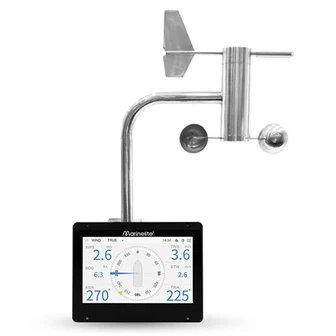

Heated Marine Anemometer for Cold Climates
Heated Marine Anemometer for Cold Climates
There is a sensor on the mast that most crews ignore until the temperature drops below freezing. The anemometer. It spins-or it tries to. But when ice builds up on the moving parts, the wind data stops. The bridge display freezes at the last reading. The autopilot loses its wind reference. And nobody notices until the vessel starts behaving strangely.
That is the problem with standard anemometers in cold climates. They work perfectly in temperate conditions. They fail exactly when you need them most-when the ice is forming, the wind is picking up, and the margin for error is smallest.
We design and manufacture our own navigation and communication equipment, including marine wind sensors. And we have spent enough time in cold-water ports to know that a heated anemometer is not a luxury. It is a requirement for any vessel operating where freezing conditions are possible.
The Ice Problem That Kills Wind Data
Ice accretion on an anemometer does two things. First, it changes the aerodynamic profile of the sensor. A cup anemometer with ice on its cups reads low because the ice changes the drag characteristics. A vane with ice on its tail responds slowly because the added weight and altered shape change its balance.
Second, ice can stop moving parts entirely. A frozen bearing locks the vane in one position. A cup assembly that cannot rotate shows zero wind speed regardless of the actual conditions. The bridge crew sees calm conditions while the vessel is actually being pushed sideways by a gale.
The consequences are not theoretical. Wind data feeds into dynamic positioning systems, autopilot steering, and navigational decision-making. Wrong wind data means wrong decisions. And in confined waters or during docking maneuvers, wrong decisions mean bent steel.
That is why a heated anemometer is the right solution for cold climates. The heating keeps the transducer faces and sensor body clear of ice. The measurement continues. The bridge gets accurate wind data regardless of the temperature.
What Heating Actually Means in Practice
Heating an anemometer is not a simple on-off switch. The power requirements are significant. A typical heated marine anemometer draws anywhere from 40 watts for basic anti-icing up to 240 watts or more for full de-icing capability. Some units designed for extreme environments feature 150 watts of electrical heating power in the sensor head alone.
The heating can be configured in different ways. Some sensors offer heating options that protect only the transducers. Others heat the sensor arm, the sensor body, or all three. The choice depends on the operating environment and the power budget available on the vessel.
Heating power is typically controlled thermostatically. The sensor activates the heater when the temperature drops below a set point and deactivates it when the temperature rises above another set point. This approach saves power in marginal conditions while ensuring full protection when it is actually needed.
The power source matters as well. Most heated anemometers operate on 24 VDC, which is standard on most vessels. Some models offer 24 VAC as an alternative. The current draw can be substantial-3 amps at 24 VDC is common for the heating element alone.
Material Choice: Why 316 Stainless Steel Matters
Cold climates are not just about temperature. They are also about salt spray, moisture, and the freeze-thaw cycle that accelerates corrosion. An anemometer that survives the cold but rusts out in six months is not a solution.
That is why 316 stainless steel is the material standard for serious marine anemometers. It resists pitting and crevice corrosion from salt water. It handles the temperature extremes without becoming brittle. It does not require painting or coating that can crack in the cold.
Some manufacturers use 316L stainless steel, which has lower carbon content and even better corrosion resistance. The material choice affects the long-term reliability of the sensor. A unit that looks identical on the outside but uses lower-grade stainless will fail sooner in a marine environment.
IP67 or IP66 protection ratings are equally important. These ratings mean the sensor can withstand immersion in water and is protected against dust ingress. In the context of a heated anemometer, the sealing also protects the internal heating elements from moisture that could cause short circuits.
The Regulatory Framework
The carriage and performance requirements for marine anemometers are set by the International Maritime Organization. Under SOLAS Chapter V, all commercial vessels over 300 gross tonnage must be equipped with certified marine anemometers capable of measuring wind speed with an accuracy of ±0.5 m/s or ±5 percent, and wind direction within ±5 degrees.
ISO 10596 specifies the type, structure, function, performance, and testing methods for marine wind vanes and anemometers. IEC 60945 and IMO Resolution A.694(17) establish the general requirements for shipborne equipment, including environmental testing for temperature extremes, vibration, humidity, and salt spray.
Why We Build Our Own
We design our own marine wind sensors because we have seen too many shortcuts. We have watched standard anemometers fail in the first freeze because nobody thought about ice. We have seen heated units that drew so much power they tripped the breaker at the worst possible moment. We have seen sensors that passed the type approval but failed the real-world test because the heating was not designed for the actual conditions on the vessel.
When we build a heated marine anemometer, we start with 316 stainless steel. We design the sensors to withstand the freeze-thaw cycle. We size the heating elements for the power budgets that vessels actually have. We test the units in cold chambers and salt spray cabinets before they ever see a vessel.
The goal is simple: accurate wind data in any condition, at any temperature, in any weather. Because wind data is not optional. And ice is not an excuse.